Posts in Tag: Show don’t tell

The pitch that should have failed

12 years ago, my wife and I landed a surprise hit in the German toy market. As total nobodies in the industry. We ignored every single piece of expert advice. Really, our pitch would fail every single test by every single expert.

It worked out beautifully for us. The reason why is relevant to every pitch and every spotlight moment.

So, what happened?

My wife and I were sitting in our garden, the spring sun shining brightly, when she suddenly said about one of her plush designs: “We should bring these into the hands of many more children. Let’s ask Schmidt Spiele if they want to publish them.”

Schmidt Spiele. One of Germany’s big toy brands.

We had never sold a single toy. We knew nobody in the industry. We had no connections. No industry experience. We were a school teacher and a leadership communication coach.

But still … we sent them an email that afternoon: three paragraphs long with a short video attached.

The next morning, we woke up to a reply asking if we could send prototypes.

A week later, their managing director sat in our living room negotiating a worldwide licensing deal.

I still remember that surreal feeling of sitting there, in our own living room, discussing worldwide licensing rights while prototypes were lying on the table between coffee cups and children’s drawings.

And it all happened because of that tiny video. Do you want to know what was in it? Children playing with the toy. That’s it.

The product was a range of mood-changing plushies. Flip the head and the character transforms. Anxious to cool. Sleepy to party. Angry to happy. We just showed what happened when a child picked it up.

Every expert in the toy industry would have told us our pitch was wrong. We didn’t explain the market opportunity. We didn’t describe how we built it. We didn’t perform our passion for the project or outline our vision for where the brand could go in five years. It contained no market data. No team credentials. No growth forecast. No strategic roadmap. Really, nothing you’d expect from a normal pitch.

So, how on Earth could it work?

The publisher watched that video and saw one thing: their own future. They could see the toy in action. They could see why children would love it. They had enough experience to manufacture it. In other words, they could already see themselves selling it in large amounts.

We didn’t tell them any of that. They saw it.

This is what every great pitch does, whether you’re selling a toy, a strategy, or a vision to your organization. Your audience isn’t asking: are these people smart enough to pull this off? They’re asking one thing: Can I see this working for us? The clearer they can see it, the less you need to persuade.

So, what the video really did was pull the future into the present. It removed the distance between the idea and reality. (In fact, they liked the video so much that they later had an agency re-shoot it and turn it into a professional ad that aired on national TV.)

But there’s one more important detail.

The product itself told exactly one story.

Not twelve. Not five. One.

The toy that changes its mood.

That simple story made the product easy to understand, easy to remember, and easy to pass alonginside meetings. You can almost hear it: “It’s the plushie that changes its mood.”

Done. No explanation needed.

The same principle applies to every strategy you present, every change initiative you propose, every vision you ask people to follow. One clear story, told simply enough that people can clearly pass it along when you’re not in the room.

We used the same two principles (pulling the future into the present and distilling it into a clear pass along message) to land four more deals after that. It became the beginning of an extraordinary chapter in our lives with five consecutive hit products, including The Grumbletroll, Furlocks, Sleepy Caps, and Nuffi, several of them supported by national TV campaigns.

Compare that to the usual dazzling that happens in pitches. You spend months building spectacular decks. Go into incredible detail. Find big words. Overexplain, for example by including the psychology of mood regulation in early childhood. 

When the moment counts, that’s exactly the urge. To impress. To make it look a little fancier. To persuade just a little harder.

Rather than find the simple true story that lets your audience experience the future with your idea in it.

The question is: when your moment counts, will your story make the future feel clear and irresistible?

Keep lighting the path,
Michael
When ambition isn’t enough

Have you ever had a problem that everyone saw, but no one acted?
That’s exactly what happened to my client.

A couple of years ago a client of mine faced a difficult situation when customer complaints were on the rise due to quality issues.

The worst part of the problem was that it wasn’t a single issue, such as a design mistake, that could easily be fixed. Over the years, many smaller issues were overlooked, slowly piling up, until they became one major problem:

Outdated protocols, incomplete processes, quick fixes, …

The sort of issues that an experienced, well-coordinated team would simply work around, but as time passed and team members left, knowledge had faded and errors increased.

As soon as the leadership team saw the big picture, they immediately launched an initiative to solve the problem:

Reduce customer complaints by half over the next 12 months!

They designed fancy slogans and posters, announcing the initiative. There was a town hall and the employees resonated well with the launch. Everyone agreed that this was very important.

The only problem?
Well, nothing changed!

Everyone agreed on the importance of the initiative.
They believed in the goal.
But no one actually acted on it.

That’s when my phone rang.

The leadership team wanted to understand what went wrong.

When we looked at the words they used, it became clear that it wasn’t so much a strategy as a goal. The goal was clear: Reduce complaints by half. But the actions weren’t.

What was supposed of the workers down the line? The project managers? The supervisors?

Leadership had hoped for signals and ideas from those closest to the production to spot weaknesses. But they had left the actual ask abstract and vague.

So we designed a new campaign. This time, it wasn’t about goals but about actions.

In fact, we took the few ideas that had been brought up and amplified them. For example, Sarah spotted a glitch that had led to increased error rates, Martin suggested an improvement that meant that errors would be spotted earlier, etc.

We put their faces on the posters, accompanied by their ideas.

The difference?

The people who heard these stories thought: “That could be me! In fact, I have a similar idea. I’m going to suggest it to my boss.”

Essentially, we turned the team members into heroes. It was the posters they looked at, but it was themselves who they saw.

Previously, they had agreed to the goal, but had considered it leadership’s job to come up with ideas.

Now, they took it on themselves. They embraced the initiative because the company’s goal was aligned with their personal goals. They took action.

Ultimately, the new campaign made the team feel seen and heard. They saw how their contribution makes a difference.

Within a year, problem after problem was fixed and customer complaints were cut to a third. More importantly, improvements were made in other areas, too. The initiative sparked a ripple effect.

That’s the difference your choice of words makes. Powerful indeed.

PS: If you want to read how other teams made a difference, take a look at my new book “The PATH to Strategic Impact”.

Von ehrlichen Saftläden und sexy Früchten – CreativeMornings mit Nic Lecloux

Ach, schöne heile Werbewelt. Alles ist so frisch und sauber, so knusprig und knackig. Die Realität, zum Beispiel in der Burgerverpackung, ist dann meist, naja, sagen wir ernüchternd. So ist das eben. Die Werbung lügt und sonntags regnet’s immer. Wir haben uns irgendwie damit abgefunden. Nic Lecloux von TrueFruits findet, das geht auch anders. Denn bei seinen Smoothies gilt: “What you see is what you get”. Auf dem CreativeMornings Septemberevent in Köln hat er erklärt, was er damit genau meint.

No Tricks

Nics “Saftladen” TrueFruits ist ein junges Bonner Unternehmen, das sich ziemlich wacker neben großen Playern wie Coca-Colas Innocent und Chiquita Smoothies schlägt. Während eines Auslandssemesters hatte der damalige BWL-Student die Früchte in Flaschen entdeckt und konnte gar nicht glauben, dass es sie auf dem deutschen Markt noch gar nicht gab. Geboren war die Geschäftsidee.

Der Anspruch dabei: No Tricks. “Wir wollten von Anfang an ehrliche Produkte machen,” sagt Nic. Deshalb gibt es TrueFruits auch nur in Glasflaschen mit Aufdruck statt Etikett, die schonungslos freien Blick auf den Inhalt geben. Außerdem ist in den bunten TrueFruits tatsächlich eben nur das: echte Früchte. Und ein paar andere natürliche Zutaten, wenn das Rezept es verlangt. Aber keine Konservierungsstoffe, keine Farbstoffe und keine Konzentrate.

Mit diesem Anspruch ist TrueFruits so etwas wie das schwarze Schaf der Saftindustrie. “Den Unterschied zwischen Konzentrat und echtem Saft schmeckt doch eh keiner, wurde uns gesagt. Und dass Plastikflaschen doch viel billiger seien als Glas. Aber wir machen unsere Smoothies in erster Linie für uns selbst. Deshalb gehen wir die Sache auch ganz anders an, als das eine große Firma tun würde”.

Smoothiewerbung auf dem Klo

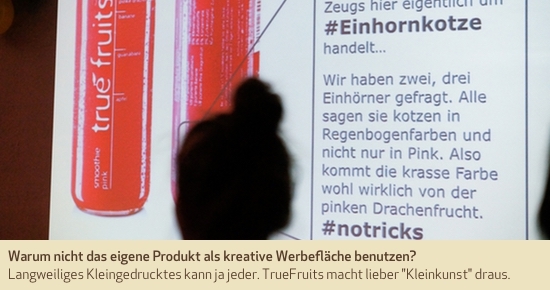
Das gilt auch für’s Marketing. Als junges Unternehmen mit kleinem Budget müssen sich Nic und sein Team allerhand einfallen lassen. Zum Beispiel Plakatwerbung auf dem Klo. Klingt erst mal komisch, leuchtet aber irgendwie ein. Denn: “Wann sonst kriegt ein Werbeplakat 15 Sekunden ungeteilte Aufmerksamkeit?” Und was liegt näher als einen gläsernen Werbeträger, der ein paar Millionen Mal im Jahr verkauft wird, auch als solchen zu benutzen? Die witzigen Texte im Kleingedruckten mit Hashtags wie #Einhornkotze oder #Ohnemett haben in den sozialen Medien schon Kultstatus erreicht.

Nic will mit seinen Smoothies nicht nur die Welt erobern. Er will auch missionieren. “Wir wollten immer schon gesunde Produkte sexy machen. Wir haben nicht verstanden, warum gesunde Produkte so bieder rüberkommen. Wir wollen, dass es cool für junge Leute ist, einen Smoothie zu trinken!”

Tüte über’m Kopf

So ganz “No Tricks” ist bei TrueFruits aber dann doch nicht alles. Als ein Zulieferer statt frischgrünem Minzpüree ein gelbbraunes Produkt aus einer anderen Minzsorte lieferte, zog das Team den Flaschen kurzerhand eine charmante Tüte über den Kopf. “Das ist Natur, die sieht halt so aus.” sagt Nic. “Aber für Impulskäufe ist die Farbe natürlich unbrauchbar. Über 50.000 Flaschen haben wir mit der Hand mit den Tüten bestückt. Die Aktion hat dann sogar dazu geführt, dass das Produkt wieder einen richtigen Anschub bekommen hat.”

Vortrag verpasst?

Hier können Sie Nics Vortrag noch mal in voller Länge ansehen.

Diese Woche geht es schon weiter mit dem “Crossover”-Vortrag von Matthias Frey und Alex Ginter zum Thema Kommunikationsdesign im studio dumont in Köln. Tickets gibt es ab heute, 20. Oktober 2014, 9:00 h hier.

Verwandte Artikel

Der Puddingbeweis – CreativeMornings mit Andreas Muxel
Schwestern von gestern – CreativeMornings mit Gregor Schwellenbach
CreativeMornings/Cologne

Was soll das bedeuten?

„Unsere innovativen Steuerungssysteme überzeugen durch ihre Stabilität and Präzision. Damit werden wir unserer Rolle als Technologieführer zum wiederholten Mal“ … blah, blah, blah.

Geht’s noch abstrakter? Noch beliebiger? Welcher LKW-Hersteller würde denn nicht behaupten, dass seine Fahrzeuge präzise zu steuern sind?

Die übliche Verteidigung lautet jetzt meist: Aber was soll ich denn sonst sagen? Unsere Systeme sind nunmal präziser und stabiler als die der Konkurrenz. Schön, dann zeigen Sie mir, was das ganz konkret bedeutet: Wie stabil ist denn „stabil“? Wie präzise ist „präzise“? Und überhaupt: Was soll das denn bei einem LKW eigentlich bedeuten, dass die Steuerung präzise arbeitet?

In einem gut einminütigen Werbeclip veranschaulicht Volvo Trucks genau das. Statt abstrakte Worthülsen zu erzählen, zeigt der Clip – mit einem wahrlich atemberaubenden Manöver – was es bedeutet, dass ein LKW präzise gesteuert werden kann:

Show, don’t tell nennt man das. Wenn Sie mir anschaulich zeigen können, was Sie sagen möchten, dann tu Sie es. Statt eines Redeschwalls aus abstrakten Worthülsen wie „Präzision“, „Innovation“ und „Flexibilität“, die für jeden Zuhörer etwas anderes bedeuten, schildern Sie eine Situation, die anschaulich zeigt, was diese Begriffe ganz konkret bedeuten: als Geschichte, als Analogie, als Foto, als Film oder mit Worten, ganz wie Sie möchten. Aber sorgen Sie dafür, dass Ihre Präsentation so konkret wie möglich wird. Erst dadurch wird sie verständlich und einprägsam. Show, don’t tell.

Verwandte Artikel

Wie BMW in die Köpfe eindringt
Kleiner Unterschied, große Wirkung
In einem Satz können wir es nicht sagen wir es mit einem Wendesatz
Was meinen Sie eigentlich mit begeistern?

Get This Moment Counts in your inbox.
How exceptional leaders communicate when the message has to land

    I value your privacy. No spam. Just “Great stuff, brilliantly articulated” (to use the words of longtime reader David).